
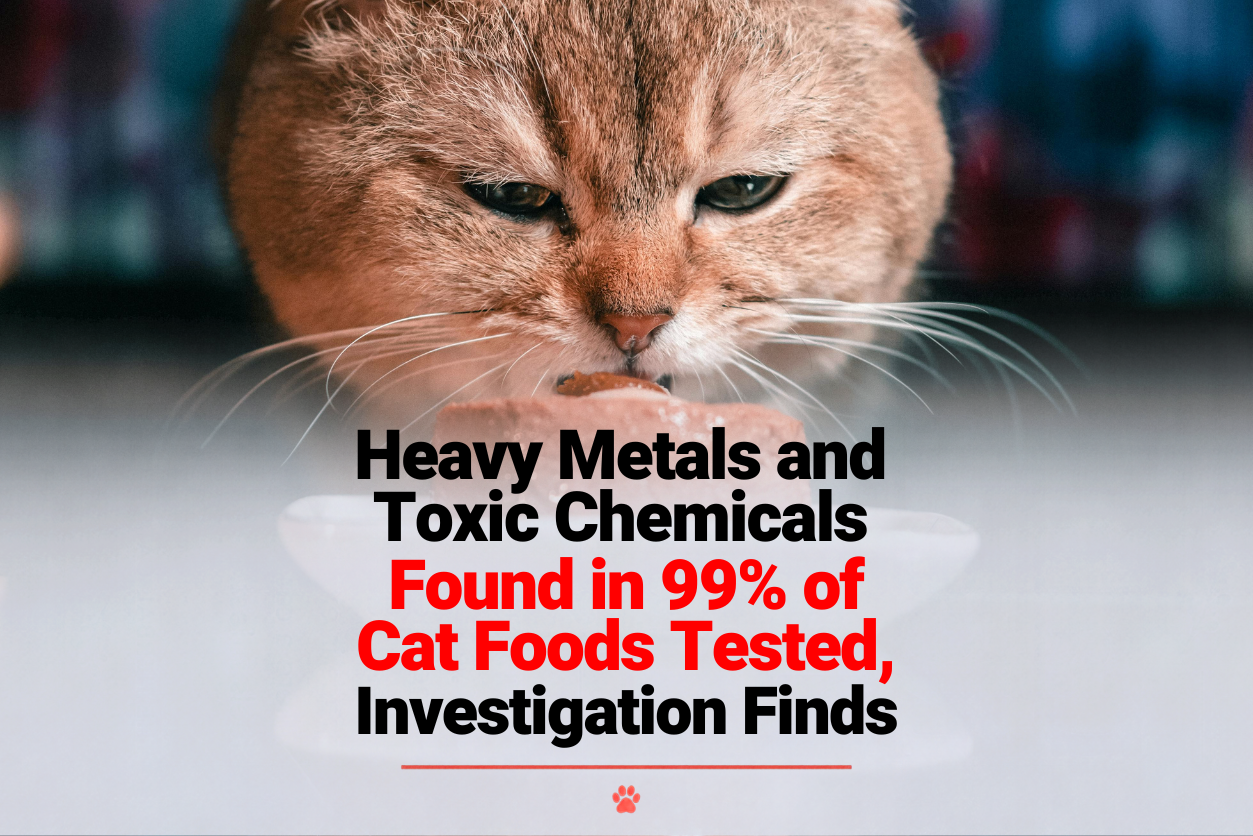
Have you heard the headlines about heavy metals in cat food after a new study found lead in 99 out of 100 foods tested? And should we be freaking out?
Freaking out is never recommended. But we should be paying attention.
In October 2026, the nonprofit Clean Label Project released the results of an independent investigation into contaminants in cat food. The organization purchased 100 cat foods from 62 brands and had them tested for more than 122 environmental and industrial contaminants, including heavy metals, pesticides, herbicides, plasticizers and processing by-products.
The headline numbers sound scary:
- Lead was detected in 99% of the foods tested.
- Cadmium was detected in 96%.
- Arsenic was detected in 94%.
But there’s an important distinction between detecting a substance and proving that the amount detected is seriously harmful. The Clean Label Project makes that distinction too. Its results compare contaminant levels between the foods tested. They are not a determination that an individual food is safe or unsafe.
So rather than panic over a headline, let’s look at what this study actually found and what we can realistically do with the information.
What Did the Clean Label Project Actually Test?
Clean Label Project (CLP) purchased 31 dry foods, 40 wet foods including cans and pouches, and 29 air-dried or freeze-dried foods. Testing was performed by an independent analytical laboratory accredited to ISO 17025 standards.
Heavy metals including lead, arsenic, cadmium and mercury were tested using ICP-MS, while other methods were used to screen for chemicals including glyphosate, pesticides, phthalates, BPA, BPS and acrylamide. One thing we appreciated about the methodology is that CLP compared contaminants per 1,000 calories rather than simply by weight of the food.
That matters because wet food contains far more water than dry food. Comparing one pound of canned food with one pound of kibble could make the wet food appear dramatically lower in contaminants simply because much of its weight is water. Looking at exposure per calorie attempts to make the comparison more meaningful for what a cat actually consumes.
Heavy Metals in Cat Food Were Common, But the Amounts Varied
The biggest headline from the study was certainly the prevalence of heavy metals in cat food. Lead appeared in 99 of the 100 products tested, cadmium in 96 and arsenic in 94.
But this is where “detected” should not automatically be confused with “dangerous.”
Heavy metals exist naturally in our environment. They can be present in soil, water and the plants and animals used to make food. Eliminating them completely from the food supply is not always possible.
What caught our attention more than the detection rate was the difference between products.
According to Clean Label Project, the cat foods with the highest lead levels contained roughly 3.5 times more lead than the typical product in the study.
To us, that is useful information.
Maybe zero exposure is not realistic. But if some manufacturers are able to produce foods with considerably lower contaminant levels than others, that raises worthwhile questions about ingredient sourcing, manufacturing and finished-product testing.
Fish-Based Cat Foods Had Much More Mercury
One of the clearest patterns in the study involved fish. After accounting for food format, fish and seafood formulas contained approximately 18 times more mercury than other protein sources. Fish-based foods also had roughly 2.5 times more cadmium. That’s not surprising.
When CLP combined this study with its previous cat food testing, marine ingredients including herring meal, tuna and fish broth showed some of the strongest associations with heavy-metal contamination.
Does this mean fish is bad for cats? No. But feeding fish on a daily basis could add up in contamination levels quickly.
Some fish-containing foods performed very well in the study. Green Juju’s Duck & Sardine Recipe, for example, made CLP’s Clean Sixteen list for dry and freeze-dried foods.
What it does reinforce for us is something we have talked about for years: variety matters.
Rather than feeding the exact same fish-based recipe every single day for years, rotating appropriate proteins and foods can help reduce reliance on one ingredient or one potential source of contaminants. This is one reason we always talk about the importance of rotating your cat’s food.
Dry Cat Food Had About Three Times More Lead
Another finding that stood out was lead. On a per-calorie basis, dry food contained approximately three times more lead than wet or air-dried foods, even when researchers accounted for protein source. Unlike mercury, CLP did not identify one particular ingredient responsible for the difference. That does not mean every dry food contained more contaminants overall than every wet food.
In fact, when CLP looked at whether foods met its complete proprietary purity standard across all of the contaminant categories, overall food-format performance was much closer.
The lead finding was specifically about lead. That is an important distinction.
Still, it adds another piece of information for cat parents to consider when choosing between different types of food, along with the nutritional and hydration differences we have discussed when looking at dry food and cats.
More Plant Ingredients Were Associated With More Glyphosate
Heavy metals were not the only thing CLP tested. Glyphosate was detected in 37% of the foods, while AMPA, one of its breakdown products, was detected in 12%. There was also an interesting pattern…
For every additional plant ingredient appearing among the first ten ingredients, glyphosate levels were associated with an increase of about 40%. The study also found that in 35 of the 100 foods, the first ingredient did not necessarily tell the whole story. A food might list chicken or fish first, for example, but then contain several different plant ingredients among the next nine ingredients – so the protein was much less in volume than the plant ingredients.
Sometimes one plant can also appear in several forms, such as pea protein and pea flour. This is often referred to as ingredient splitting. It is another reason we encourage cat parents to read beyond the first ingredient when reading a cat food label. The front of the bag is marketing. The ingredient panel tells us much more.
What About Plastics in Cat Food?
One result that did not get quite as much attention as the heavy metals involved DEHP, a phthalate plasticizer. DEHP was detected in 48 of the 100 foods tested.
Interestingly, the likelihood of detecting it was similar across food types, but CLP reported that canned and pouched foods contained about five times as much DEHP as bagged foods when compared across the study. That may involve food contact and packaging, although this study cannot prove exactly where the DEHP originated.
There was some encouraging packaging news too. BPA was detected in only two products, and BPS in only one. CLP believes this may reflect the industry’s broader move away from bisphenols in food packaging.
We think that’s worth mentioning because the goal of studies like this should not only be to point out what is wrong. When contaminant levels decrease, that matters too.
What Were the Cleanest Cat Foods Tested?
Clean Label Project created two Clean Sixteen lists: one for wet foods and another for dry, air-dried and freeze-dried foods. These were the products with the lowest cumulative contaminant scores among the foods tested.
That doesn’t mean they are contaminant-free, and it is not an endorsement of their nutritional quality. The Clean Sixteen ranking is specifically about the contaminant panels CLP tested.
We were especially happy to see two foods from companies we have talked about before make the dry and freeze-dried list:
- Green Juju Duck & Sardine Recipe
- Smallbatch Freeze-Dried Meal Bites, Turkey Recipe
Both landed among CLP’s 16 highest-rated dry and freeze-dried foods for purity in this particular study.
There is also an important point to make about any brand that did not make the list. CLP specifically cautions that absence from the Clean Sixteen does not mean a food violated federal or state regulations or even that it had unusually high contaminant levels. It simply was not one of the top 16 in that comparison.
Does the FDA Limit Heavy Metals in Cat Food?
This is where the conversation gets complicated.
When it comes to heavy metals in animal food/feed, the FDA’s Center for Veterinary Medicine has stated that it has not established specific guidance, action levels or tolerances for heavy-metal levels in animal food. Instead, the FDA says it can take action on a case-by-case basis when an animal food is considered adulterated, using other references such as National Research Council and AAFCO information.
Pet food consumer advocate Susan Thixton of Truth About Pet Food has argued that this leaves an important regulatory gap, particularly when we are thinking about chronic exposure over the lifetime of a pet rather than an acute poisoning event.
We think this is an important distinction.
It may not be accurate to say that any amount of heavy metal is automatically dangerous. But it is also fair for cat parents to ask why there are not clearer, modern, cat-specific benchmarks for long-term dietary exposure.
So What Should Cat Parents Actually Do?
This is the part that matters most to us. You don’t need to panic and throw away every food in your house. This study is not something we should be afraid of. It’s information we can use to make better, more informed choices.
Rotate foods as much as you can.
Instead of feeding the exact same recipe, protein and brand for years, consider appropriate variety. Rotation can reduce reliance on one ingredient source and gives us another reason not to put all of our nutritional eggs in one basket.
Do not automatically assume expensive means cleaner.
Both premium foods and everyday grocery-store foods appeared on the Clean Sixteen lists. Price and marketing do not tell us contaminant levels.
If fish is your cat’s primary protein, consider variety.
You do not need to eliminate fish because of this study. But with the much higher mercury levels CLP found in fish-based foods, rotating other proteins into the diet makes sense when your cat tolerates them.
Read the entire ingredient panel.
The first ingredient alone does not tell you everything about the food.
Ask manufacturers better questions.
One of the best may simply be: “Do you regularly test your finished cat food for lead, arsenic, cadmium and mercury?”
Testing raw ingredients is useful, but testing the finished product tells us what actually ended up in the bowl. We all know that the most technically “perfect” food in the world does not help a cat who refuses to eat it. Any diet change needs to take the individual cat, their health, their nutritional requirements and their willingness to eat into account.
What This Study Does and Does Not Tell Us
The Clean Label Project study gives us something we have wanted more of in the pet food industry for a long time: Actual testing data. But it is not the final answer.
The study tested one batch of each of 100 foods. It did not establish that a particular contaminant level caused disease, and it did not rank the nutritional quality of the foods. CLP also does not publicly release the individual numerical results for every product.
What it did demonstrate is that contaminant levels vary substantially between foods and that measurable patterns exist involving protein sources, ingredients, food formats and packaging. That’s information worth having. Because when we know better, we can ask better questions. And manufacturers know we are asking them.
The Bottom Line on Heavy Metals in Cat Food
Yes, heavy metals in cat food are common. According to Clean Label Project’s 2026 testing, lead was detected in 99% of the foods tested, cadmium in 96% and arsenic in 94%. But those numbers do not mean 99% of cat food is toxic.
The more useful story is that some foods contained substantially lower levels than others, fish-based foods tended to contain much more mercury, dry foods contained more lead on a per-calorie basis, and foods with more plant ingredients tended to contain more glyphosate.
That is why our takeaway is not fear. It is awareness.
Read labels. Rotate foods and proteins when appropriate. Ask companies whether they are testing finished products. Pay attention when independent testing becomes available. And keep learning, sharing and growing.
Because our cats deserve informed choices, not scary headlines.
Frequently Asked Questions About Heavy Metals in Cat Food
Are Heavy Metals in Cat Food Dangerous?
The presence of a heavy metal does not automatically mean a food is dangerous. Risk depends on factors including the specific metal, concentration, amount consumed and duration of exposure. The CLP study compared contaminant levels between products. It did not determine that individual products caused harm.
Does Dry Cat Food Contain More Heavy Metals Than Wet Food?
The CLP study found that dry food contained approximately three times more lead per 1,000 calories than wet or air-dried food. That does not mean every dry food was more contaminated overall, because other contaminants varied by food type and ingredient.
Does Fish-Based Cat Food Contain More Mercury?
Fish and seafood-based foods contained about 18 times more mercury than foods based on other proteins after researchers accounted for food format. Some fish-containing foods still ranked among the cleaner products tested.
Which Cat Foods Had the Lowest Contaminant Levels?
Clean Label Project published two Clean Sixteen lists identifying 16 wet foods and 16 dry, air-dried or freeze-dried foods with the lowest cumulative contaminant scores in its testing. Green Juju Duck & Sardine and Smallbatch Turkey Freeze-Dried Meal Bites were among the dry and freeze-dried selections.
How Can I Reduce My Cat’s Exposure to Contaminants?
There is no realistic way to eliminate every environmental contaminant from food. Practical steps include rotating appropriate foods and protein sources, reading beyond the first ingredient, avoiding reliance on fish as the only protein when possible, and asking manufacturers whether they routinely test their finished products for contaminants.