

Updated 8/10/2026
We know how scary it can be in a multicat home when you hear that combination of meowing, hissing and cats scrambling across the floor above you. Or below you. Or directly behind you while you’re making breakfast.
One minute everything’s quiet and the next, one cat is chasing another through the house at full speed and you’re wondering, “Are my cats playing or fighting?”
Sometimes the answer is pretty obvious. Other times, not so much.
Cats can play rough. They chase each other, wrestle, pounce, swat and even sometimes hiss or make noises that can sound a little dramatic. That doesn’t always mean there’s a problem.
In fact, having playmates can be a benefit of living in a multicat household. Play helps cats stay physically active, provides mental enrichment and gives them an opportunity to practice natural behaviors like stalking, chasing, pouncing and grabbing. Cats are designed to regularly move through the prey sequence, and healthy play gives them an appropriate outlet for those instincts.
But there’s a difference between two cats enjoying a good wrestling match and two cats that genuinely want the other one to GO AWAY.
So how can you tell the difference?
Signs Your Cats Are Playing
Instead of focusing on one swat, hiss or dramatic moment, watch the entire interaction and pay attention to both cats’ body language.
When cats are playing, you’ll often notice:
- They take turns chasing or being chased
• Both cats willingly come back for more
• Their bodies look relatively loose and relaxed
• Their ears are generally forward or in a neutral position
• They may wrestle, pounce and swat without causing injury
• They pause during play and then start up again
• One cat may run away, but then turn around and pounce
• They return to normal behavior when playtime is over
One of the biggest clues is reciprocity. If our cat, Friday, chases her brother, Zorro, down the hallway and five minutes later Zorro is chasing Friday back, there’s a good chance they’re having a blast.
It may look like WWE to us, but to them, it’s just another Tuesday.
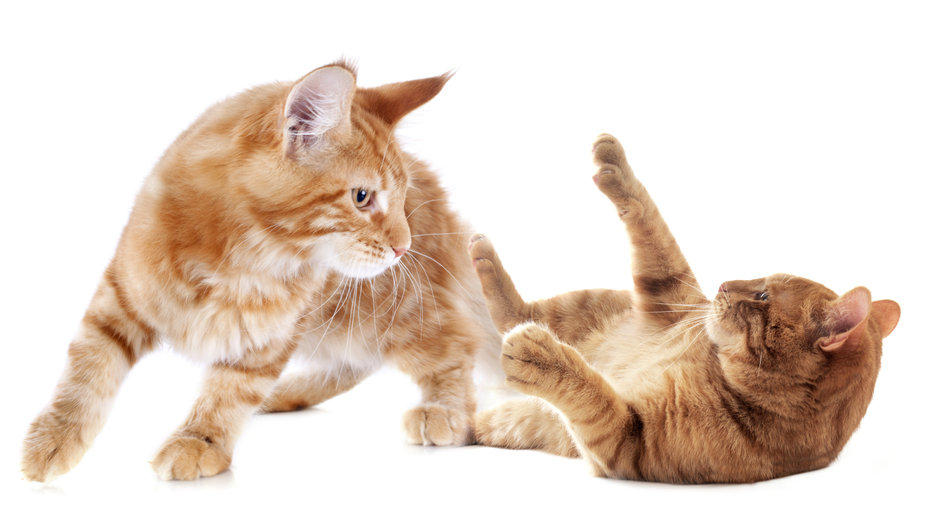
Signs Your Cats May Actually Be Fighting
A real cat fight usually has a very different energy.
Pay attention if you notice:
- One cat is chasing while the other is trying to escape
• One cat hides or avoids certain areas of the home afterward
• Their bodies become stiff and tense
• Ears are flattened back against the head
• Fur is puffed up or standing on end
• There is intense growling, yowling, screaming or other unusual vocalization
• One cat corners or blocks the other
• Fur is flying
• Scratches, bites or blood are present
• The cats regularly avoid each other outside of these interactions
That last one is especially important.
If two cats wrestle like maniacs and then curl up together on the couch an hour later, that tells you something very different than cats who have had an intense interaction and spend the rest of the day avoiding each other.
What About Hissing?
This is where things can get confusing.
A hiss doesn’t automatically mean your cats are fighting.
Hissing is communication. Sometimes it simply means, “Dude. That was too much.”
One cat may get a little carried away during play and the other may hiss, swat and walk away. If the other cat respects that boundary and everyone returns to normal, you probably don’t need to panic.
What matters is what happens next.
Does the other cat back off? Does the interaction stop? Does the cat who hissed relax and go about their day?
Or does the chasing continue while one cat is desperately trying to get away?
Your cats will tell you a lot if you watch the whole conversation instead of reacting to one sound.
Should You Break Up Cats That Are Fighting?
If your cats are genuinely fighting, yes, you should intervene. But please don’t reach your hands into the middle of a cat fight. Redirect or interrupt the interaction using a pillow or with stern words from a distance and give both cats an opportunity to separate and calm down.
And if this is happening regularly, don’t just keep breaking up fights and hoping they’ll eventually figure it out.
Repeated fighting can be a sign of stress, fear, territorial insecurity, resource competition or a damaged relationship between the cats. In those situations, it may be necessary to do some confidence building sessions, or even a brief reintroduction!
Let Cats Be Cats
As cat parents, one of the hardest things to learn is when to intervene and when to let our cats just be cats.
Not every hiss needs our help. Not every wrestling match is aggression. And not every game of chase means one cat is bullying another.
Watch their body language. Pay attention to whether both cats are participating willingly. Look at how they behave toward each other when they aren’t playing.
The goal isn’t to stop our cats from wrestling, chasing or occasionally telling each other off. These are normal feline behaviors.
Our job is to recognize when both cats are having fun and when one of them is saying, “This isn’t fun anymore.”
Because when it comes to figuring out whether your cats are playing or fighting, their body language will almost always tell you the answer.
Recommended Product To Increase Feline Energy